
Chalk Hill Figures in the Kent Downs
7th August 2026
Across the Kent Downs, distinctive figures carved into the chalk hills tell stories of local history, remembrance and celebration. Some have watched over their villages for more than a century, while others are more recent additions to the landscape.
But what are these landmarks, why were they created, and where can you see them?
What is a hill figure?
Hill figures, also known as chalk figures or geoglyphs, are large visual representations created on hillsides by exposing the chalk beneath the grass and soil.
There are more than 50 hill figures across the UK, with many found on the chalk downland of southern England. White horses are the most common, although crosses, military badges and other designs can also be found.
The oldest and most famous is the Uffington White Horse in Oxfordshire, which is thought to date back around 3,000 years.
The Kent Downs has four distinctive hill figures, each with a different story and connection to the communities and landscape around it.
Hill figures in the Kent Downs
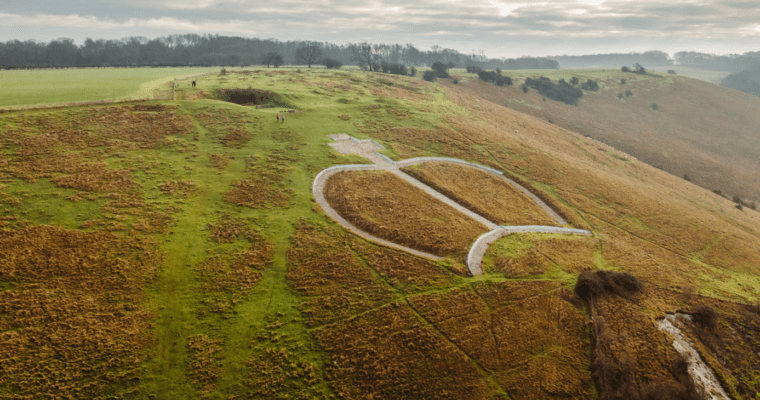
Wye Memorial Crown
The Wye Memorial Crown was created in 1902 to celebrate the coronation of King Edward VII. The idea came from the principal of Wye Agricultural College, and on the night of the coronation, the crown was illuminated with bonfires.
Two years later, King Edward VII stayed at Eastwell Manor near Ashford and was able to see the illuminated crown for himself.
The 180-foot-tall crown was later hidden during the Second World War, along with the memorial crosses at Shoreham and Lenham. Covering the figures prevented them from being used as navigational landmarks by enemy aircraft.
Today, the Wye Crown can be reached on foot and sits beneath the North Downs Way National Trail. The surrounding hillside provides impressive views across Wye and the wider Kent Downs.
Shoreham Memorial Cross
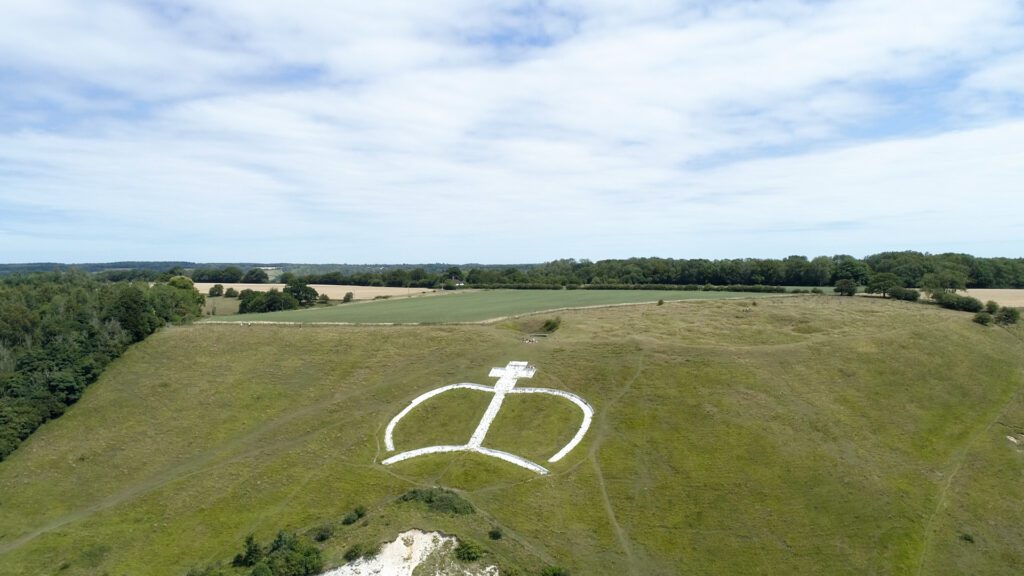
The Shoreham Memorial Cross stands on the hillside west of Shoreham village and was created as a memorial to local men who lost their lives during the First World War.
The project was championed by local man Samuel Cheeseman, whose two sons were killed while serving. He wanted to commemorate them alongside the 48 other men from Shoreham who died during the war.
Local landowner and war veteran Francis Mildmay donated the site, and the cross was completed in September 1921 after 16 months of work.
The memorial became part of Shoreham’s annual remembrance tradition. Samuel Cheeseman would even pull a small cannon up the hill to the cross for the service.
The cross can be seen from Shoreham village, while a public footpath leads uphill to the memorial.
Lenham Memorial Cross
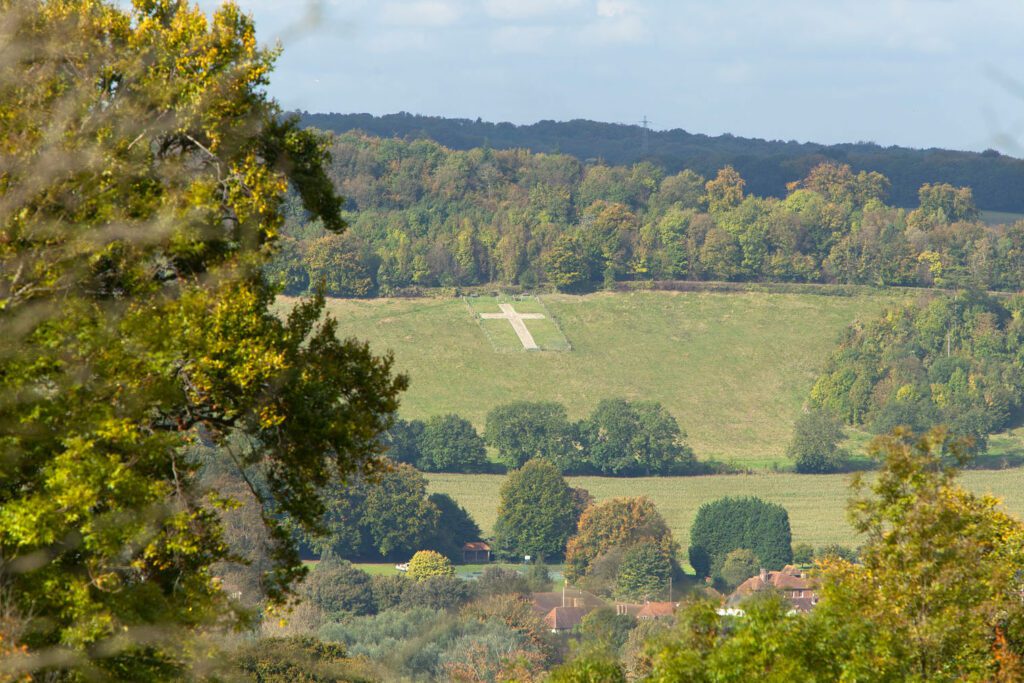
Above the village of Lenham stands another striking memorial landmark: the Lenham Memorial Cross.
The cross commemorates 56 men from the parish who lost their lives during the First and Second World Wars. It was designed by the headmaster of Lenham School and constructed on the North Downs in 1922.
During the Second World War, the cross was covered with earth to prevent it being used as a landmark by enemy aircraft. It was uncovered again in 1945.
An annual memorial service continued at the site until 1960. In 1977, the dedicatory stones at the foot of the cross were moved to Lenham Church, allowing surviving relatives to continue visiting the names of those remembered.
Historic England registered the cross as a National Monument and War Memorial in December 2017.
The Lenham Cross can be seen from the A20, while the site can be reached via the North Downs Way trail.
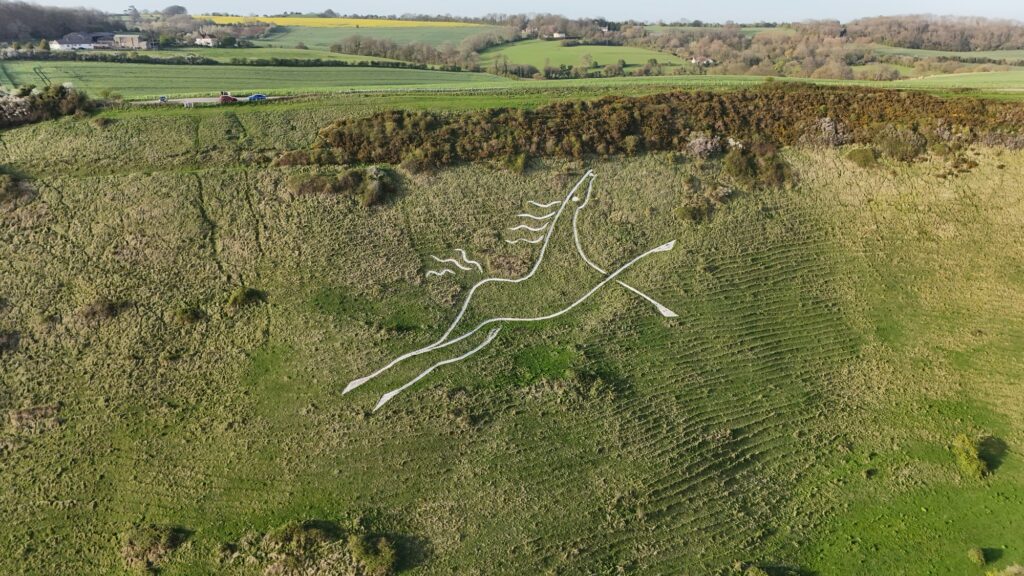
Folkestone White Horse
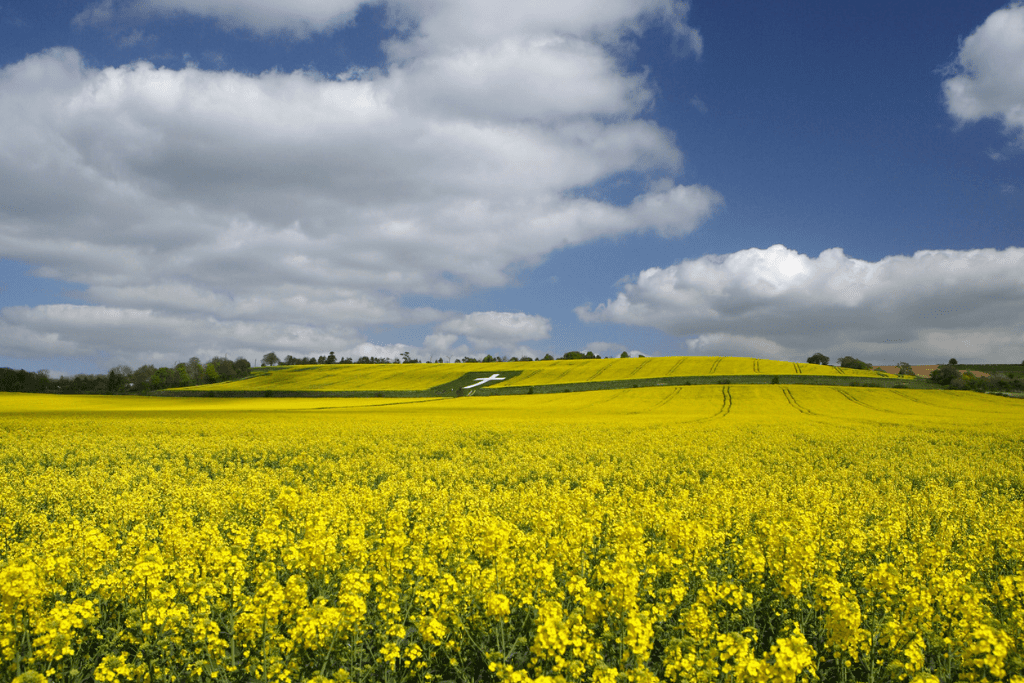
The Folkestone White Horse is the youngest of the four hill figures in the Kent Downs. It was completed in 2003 after local artist Charlie Newington conceived the idea in 1998 as a millennium landmark.
Newington’s design was inspired by the Uffington White Horse in Oxfordshire. The proposal attracted controversy because the chosen site was home to rare plant species. Following a public inquiry, planning permission was granted in 2002 and work began.
Rather than cutting the image directly into the hillside, chalk blocks were laid on the ground to create the horse. Gurkha soldiers spent seven days constructing the figure, which was completed in summer 2003. A time capsule was later buried beneath the horse’s heart in 2004.
The white horse was dedicated to the people of Folkestone and has become a recognisable symbol of the town, even appearing in the logo of Folkestone & Hythe District Council.
The figure sits on a steep slope within a Site of Special Scientific Interest (SSSI) and Special Area of Conservation (SAC), so care should be taken when visiting.
There are excellent views of the horse across Folkestone, including from the public footpath below the hill. The North Downs Way passes above the figure, with panoramic views across Folkestone, the Strait of Dover and, on a clear day, towards France.
Discover the hill figures of the Kent Downs
These four landmarks are a reminder that the Kent Downs is shaped by more than its geology and natural beauty. Its hills and valleys also hold stories of communities, conflict, celebration and remembrance.
The hill figures offer a fascinating way to discover the history of the Kent Downs, with several located along or close to popular walking routes.
If you’re planning a walk to see one of these landmarks, check current access information before setting out and follow local signs and public rights of way.
Popular articles
The Best Viewpoints in the Kent Downs
Searching for incredible views? Look no further! We've rounded up the best…
Top 6 bluebell walks in the Kent Downs
If you're looking for inspiration on the best places for some bluebell…
Lambing season in the Kent Downs
Discover the importance of lambing season in the Kent Downs and find…