
A guide to night sky watching in the Kent Downs
30th September 2026
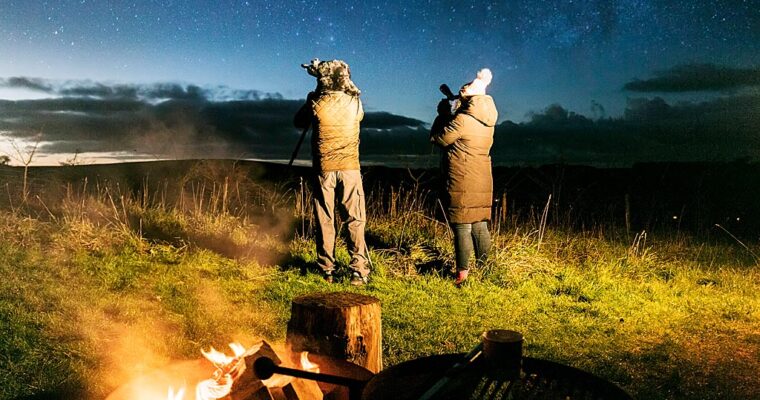
If you’ve ever looked up at the night sky and wished you could reach out and touch the stars, the Kent Downs is a surprisingly good place to do it in southeast England. The countryside here has lower light pollution than towns and cities, giving you a clearer view of bright stars, planets and occasional shooting stars. While the Milky Way is rarely visible as a bold band, you can still see much more of the night sky than you would in a town or city.
The geography helps too. The chalk hills rise above some of the surrounding villages, giving you wider horizons. The valleys and ridges can block some nearby lights, and open fields or hilltops give you more of the sky to look across. At night, the landscape itself becomes part of the experience. You’ll see familiar fields, woodland and chalk hills in a completely different light, while the changing sky above gives you another way to experience the Downs.
Here are some places where you can enjoy a night under the stars and experience the Downs after dark.
Toys Hill
Toys Hill sits on a plateau in the western Downs with far-reaching views. Its position above the surrounding land gives you a good sense of the wider landscape, with woodland around the edges and open views beyond. On a clear night, you can pick out bright stars and planets above the countryside.
Take a gentle walk along the ridge before dusk, then find a spot to pause as the stars begin to appear. Give your eyes a little time to adjust and you’ll start to notice stars that are difficult to pick out in a town, and you may even catch a meteor streaking across the sky.
Kingsdown Beach
Kingsdown gives you something you won’t get at an inland viewpoint: a wide, open horizon across the English Channel. Away from direct lights, you can watch the stars appear above the dark line of the sea.
As the light fades, the beach and sea become part of the view too. It can feel wonderfully quiet, with the stars above you and the Channel stretching out ahead. Bring warm layers and a torch for the walk back, and check local parking and access arrangements before you go.
Perry Wood
Perry Wood near Faversham gives you a very different setting. The woodland sits among the rolling chalk of the Downs, with views towards the coast and countryside from the viewpoint known as The Mount.
You won’t have the same wide horizon as at Farthing Common, but that’s part of the appeal. You can look through clearings and across the surrounding landscape, taking in the countryside as well as the sky above you.
Perry Wood has also been used for dark-sky events, making it an interesting place to consider if you’re taking part in an organised stargazing event.
Betsom’s Hill
At 251 metres, Betsom’s Hill is the highest point in historic Kent. Its elevated position gives you a sense of the wider landscape, with views across valleys and fields.
If you’re watching a meteor shower, an open view of the sky can help you spot meteors as they appear across different parts of the sky. Take care around roads and use established access routes if you’re visiting after dark.
Farthing Common and Postling Down
Farthing Common on the eastern edge of the Downs offers wide views and an open aspect across the surrounding countryside. There’s a small hilltop car park, and the nearby chalk grassland at Postling Down gives you another open landscape in which to experience the sky after dark.
You don’t need specialist equipment to enjoy it. Find a comfortable spot, give your eyes time to adjust and look out across the landscape as the stars begin to appear. On a clear night, the view of the stars above the chalk downland can be striking.
Blue Bell Hill
The chalk ridge at Blue Bell Hill, near Detling, gives you views across the Medway Valley and a changing landscape as daylight fades.
Nearby towns and roads mean the area is affected by artificial light, so you won’t see as many faint stars as you might in a more rural part of the Downs. But on a clear night, you can still pick out bright stars, constellations and planets while looking out across the valley below.
Hucking Estate
Hucking Estate is a large landscape of ancient woodland, chalk grassland, hedges and open ground on the North Downs. The estate reaches the escarpment and has far-reaching views across the surrounding countryside.
It is also a good place to notice how the landscape changes after dark. Fields, woodland edges and old droveways that are familiar in daylight take on a different character beneath the night sky.
There are waymarked trails and public access, but paths can be uneven, muddy and steep in places. If you’re planning to visit after dark, check access arrangements first and stick to established routes.
What you can actually see
In the Kent Downs on a clear night away from direct lights, you’re likely to see:
- Bright constellations such as Orion in winter, Cassiopeia in autumn and winter, and Lyra in summer
- Planets such as Jupiter, Venus, Mars or Saturn when they are above the horizon
- Meteors during peak meteor showers
- Brighter stars that are harder to pick out from towns and cities
What you see will depend on the time of year, cloud cover, the Moon, and how much artificial light reaches your location. A bright Moon can make fainter stars much harder to see, so a night around the new moon can give you darker conditions.
The Kent Downs may not offer the completely dark skies found in remote reserves, but you can still have a memorable night outdoors. Look up at the stars, but take a moment to look around too. The hills, valleys, woodland and coast all look different after sunset, and the night sky becomes part of that landscape.
Tips for your night under the stars
- Check the weather and Moon phase before you go. Clear skies and less moonlight mean more stars.
- Give your eyes time to adjust and avoid bright phone screens where you can.
- Bring warm layers, a blanket and a flask. It can get chilly once you stop moving.
- Take binoculars if you have them, but you don’t need specialist equipment to enjoy the night sky.
- Check access and parking arrangements before you go, and stick to public rights of way.
- Keep lights, noise and litter to a minimum to help protect the landscape and wildlife.
For more advice, see our 10 top tips for enjoying the outdoors while staying safe.
Popular articles
The Best Viewpoints in the Kent Downs
Searching for incredible views? Look no further! We've rounded up the best…
Top 6 bluebell walks in the Kent Downs
If you're looking for inspiration on the best places for some bluebell…
Lambing season in the Kent Downs
Discover the importance of lambing season in the Kent Downs and find…